Compromise is the heart of politics. Unfortunately for California, the state may go off the cliff tonight because the governor and Republican legislators are uninterested in the concept. So, Californian may begin issuing IOUs for the second time in its history on July 2.
After saying for months that it’s the Legislature’s job to pass a budget, the governor has suddenly decided that he wants to dictate the terms of any budget agreement. But sweeping policy changes to CalWORKS, Medi-Cal, and state employment deserve a public vetting. The governor had all year to make public any of these proposals in his State of the State address, his address after the special election, or any of his four May Revision budget proposals.
And, contrary to their claims of wanting “sunshine and accountability” during budget negotiations, Republicans in the Legislature have never offered a comprehensive budget alternative for the public to consider. Like the governor, they want to negotiate a backroom deal in secret.
The public deserves better than that. We had a month of public hearings within the Conference Committee process. That was the appropriate time and place for budget proposals to be vetted. The budget belongs to the people of this state. The Conference Committee process was the public’s opportunity to weigh in on it. That is why we took over 30 hours of public comment.
But California’s fiscal crisis is bigger than any single person or political party in Sacramento. All legislators and the governor have taken oaths of office to serve the people of this state. All of us must make sacrifices in order to reach a budget agreement that can take effect immediately.
Absent that, the Democrats took responsibility for the state and sent the governor elements of our own budget plan. SBx3 16 included over $7.9 billion in spending reductions and SBx3 17 included $4.4 billion in accelerated revenues and tax compliance provisions, including some of the governor’s own proposals. The governor just dug in deeper and vetoed them.
And, absent Senate Republican support before midnight tonight for the SB 64 and SB 80, passed with strong bipartisan support by the Assembly last Thursday, we incur $7 billion in lost savings and new costs.
In the meantime, the clock keeps ticking towards IOUs. Those state payments subject to IOUs are listed here.

Tuesday, June 30, 2009
Monday, June 29, 2009
No Plan B, Governor?
The Assembly passed three bills providing cash solutions to keep the state from issuing IOUs on July 2. Republicans in the Senate still refuse to support these solutions, which means that we will lose over $3 billion.
Recognizing that these are the governor’s proposals, Senate Budget Chair Denise Moreno Ducheny and I sent a letter to the governor’s Department of Finance today to ask for the governor’s backup plan. Our letter reads:
“As Chairwomen of the respective Budget Committees, we request that you outline, by close of business today, how your administration specifically plans to fill the $3.3 billion hole through 2009-2010, if the measures are not enacted.”
The response from Mike Genest, Director of the Department of Finance, states:
“…we have not developed a specific plan for addressing the potential loss of these solutions.”
In addition, the governor is holding the state hostage. As part of a budget agreement, he has submitted a list of new demands – sweeping policy changes – which could have been submitted with one of any of his four May Revision budget proposals. Now, he wants to reduce what the state contributes in pensions for new hires, change state retiree health care, scale back eligibility for people in the welfare-to-work program, create rules to root out fraud in-home services, and change portions of Medi-Cal.
While I am not averse to discussing these issues, none of them are simple subjects with simple solutions. The governor can’t lose focus on the real problem. His new demands don’t solve the immediate cash crisis. We have 30 hours until California faces financial ruin.
These are disappointing developments. The governor himself has imposed a July 1 deadline for passing a budget revision, yet he continues to throw roadblocks in our way.
Recognizing that these are the governor’s proposals, Senate Budget Chair Denise Moreno Ducheny and I sent a letter to the governor’s Department of Finance today to ask for the governor’s backup plan. Our letter reads:
“As Chairwomen of the respective Budget Committees, we request that you outline, by close of business today, how your administration specifically plans to fill the $3.3 billion hole through 2009-2010, if the measures are not enacted.”
The response from Mike Genest, Director of the Department of Finance, states:
“…we have not developed a specific plan for addressing the potential loss of these solutions.”
In addition, the governor is holding the state hostage. As part of a budget agreement, he has submitted a list of new demands – sweeping policy changes – which could have been submitted with one of any of his four May Revision budget proposals. Now, he wants to reduce what the state contributes in pensions for new hires, change state retiree health care, scale back eligibility for people in the welfare-to-work program, create rules to root out fraud in-home services, and change portions of Medi-Cal.
While I am not averse to discussing these issues, none of them are simple subjects with simple solutions. The governor can’t lose focus on the real problem. His new demands don’t solve the immediate cash crisis. We have 30 hours until California faces financial ruin.
These are disappointing developments. The governor himself has imposed a July 1 deadline for passing a budget revision, yet he continues to throw roadblocks in our way.

Sunday, June 28, 2009
48 Hours from Edge, Assembly Moves Majority Vote Budget
Late into the night, the Assembly Democrats moved a budget revision to close our $19.5 billion deficit and provide a $4 billion budget reserve through a package of bills that only required a majority vote to pass.
The majority approach was not our first choice. We spent weeks in Conference Committee pursuing a bipartisan budget solution. But we have hit a wall. And, we cannot afford to wait any longer. We are 48 hours away from the state plunging into financial ruin. The Legislature has a duty to act with or without Republicans for the good of California.
There is no duty more fundamental for a Legislator than preventing the state from sinking into insolvency. This is not a political game. Unfortunately, some Republicans forget that.
As the old saying goes: lead, follow, or get out of the way. By voting against cuts and revenues tonight, the basis of any budget, Republicans ran from their responsibility to govern.
We gave legislative Republicans a chance to lead with us through a month of public hearings in the Conference Committee. That was the opportunity to present alternative budget proposals. Republicans squandered this opportunity.
With just 48 hours until our state begins issuing IOUs, now is not the time to come forward with sweeping ideas that will take more time to responsibly study than we have to act. As was noted by Assembly Speaker Karen Bass, to insist upon this as a negotiating tactic is no different than hijacking an ambulance.
Tomorrow, we expect the Senate will begin session to take up this majority vote budget. If it passes, the governor will finally get what he has asked for: a budget that resolves the entirety of our budget deficit with an adequate reserve.
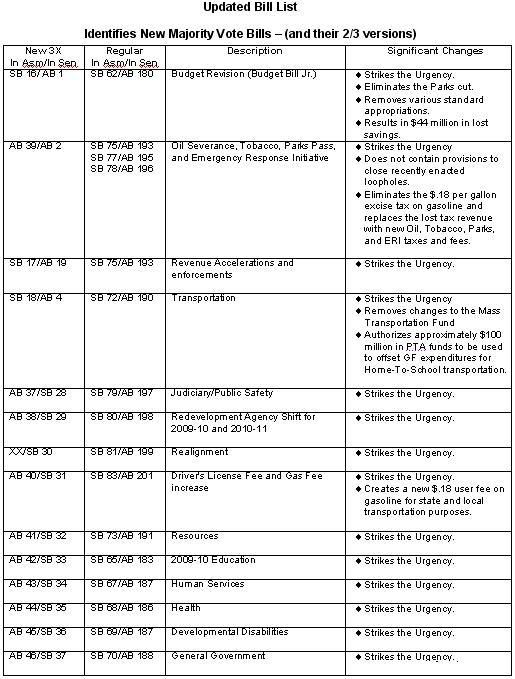
While a complete analysis of this budget package will soon be available here, the budget passed by Assembly Democrats is largely based on the Conference Budget. When broken down by the individual bills within the budget package, the distinctions are within the chart below.
The majority approach was not our first choice. We spent weeks in Conference Committee pursuing a bipartisan budget solution. But we have hit a wall. And, we cannot afford to wait any longer. We are 48 hours away from the state plunging into financial ruin. The Legislature has a duty to act with or without Republicans for the good of California.
There is no duty more fundamental for a Legislator than preventing the state from sinking into insolvency. This is not a political game. Unfortunately, some Republicans forget that.
As the old saying goes: lead, follow, or get out of the way. By voting against cuts and revenues tonight, the basis of any budget, Republicans ran from their responsibility to govern.
We gave legislative Republicans a chance to lead with us through a month of public hearings in the Conference Committee. That was the opportunity to present alternative budget proposals. Republicans squandered this opportunity.
With just 48 hours until our state begins issuing IOUs, now is not the time to come forward with sweeping ideas that will take more time to responsibly study than we have to act. As was noted by Assembly Speaker Karen Bass, to insist upon this as a negotiating tactic is no different than hijacking an ambulance.
Tomorrow, we expect the Senate will begin session to take up this majority vote budget. If it passes, the governor will finally get what he has asked for: a budget that resolves the entirety of our budget deficit with an adequate reserve.
While a complete analysis of this budget package will soon be available here, the budget passed by Assembly Democrats is largely based on the Conference Budget. When broken down by the individual bills within the budget package, the distinctions are within the chart below.
Friday, June 26, 2009
102 Hours to the Edge
Over the last three days, the Legislature has been voting on elements of a budget revision package. The Assembly has taken up four bills totaling nearly $12.4 billion in cuts and savings towards our $19.5 billion deficit. Today, the Senate attempted to go even further toward closing the deficit, voting on other components of the budget package but obtaining no Republican support.
With just a little over 100 hours until the state plunges into financial ruin, I wonder when at least the bare minimum of Republicans will come out of their corners and do the business of governing that this state so desperately needs. We only need 4 Republicans in the Assembly and 2 in the Senate to pass these budget revisions, and, of course, 1 governor to sign it.
I am encouraged by the Assembly Republican leadership’s interest in working over the weekend to find common ground and reach an agreement. I was proud of our bipartisan approach taken yesterday when we passed three bills enabling the State Controller to pay the state’s bills this summer. These bills were not passed with a bare minimum of support, but in a nearly unanimous bipartisan effort. Nevertheless, the governor and Senate Republicans quashed yesterday’s fledgling bipartisan effort.
But here’s the real rub. Neither the governor nor Senate Republicans are offering solutions toward an agreement.
As the old saying goes, it’s deja vu all over again. The governor makes threats on an almost daily basis. Today’s threat is a third furlough day each month for state workers if we don’t send him a $24 billion budget solution all at once.
And, Senate Republicans are in tow. They apparently voted down the budget bills over the past three days because they were not solving the entire budget deficit all in one day. They also say that they want up to another $8 billion in cuts to reach any budget agreement but refuse to say where and how such cuts should be made. Recognizing their refusal to cut public safety or prisons, cuts of this scale can only come from education and eliminating the health and human services safety net.
The bottom line remains the same: we need to pass a budget package within a matter of hours. That means the governor and Senate Republicans must rise to the occasion and work with Democrats and Assembly Republicans to guide our state through this financial crisis. This is not a game. This is not a drill. The cost of their bravado is the financial ruin of California.
With just a little over 100 hours until the state plunges into financial ruin, I wonder when at least the bare minimum of Republicans will come out of their corners and do the business of governing that this state so desperately needs. We only need 4 Republicans in the Assembly and 2 in the Senate to pass these budget revisions, and, of course, 1 governor to sign it.
I am encouraged by the Assembly Republican leadership’s interest in working over the weekend to find common ground and reach an agreement. I was proud of our bipartisan approach taken yesterday when we passed three bills enabling the State Controller to pay the state’s bills this summer. These bills were not passed with a bare minimum of support, but in a nearly unanimous bipartisan effort. Nevertheless, the governor and Senate Republicans quashed yesterday’s fledgling bipartisan effort.
But here’s the real rub. Neither the governor nor Senate Republicans are offering solutions toward an agreement.
As the old saying goes, it’s deja vu all over again. The governor makes threats on an almost daily basis. Today’s threat is a third furlough day each month for state workers if we don’t send him a $24 billion budget solution all at once.
And, Senate Republicans are in tow. They apparently voted down the budget bills over the past three days because they were not solving the entire budget deficit all in one day. They also say that they want up to another $8 billion in cuts to reach any budget agreement but refuse to say where and how such cuts should be made. Recognizing their refusal to cut public safety or prisons, cuts of this scale can only come from education and eliminating the health and human services safety net.
The bottom line remains the same: we need to pass a budget package within a matter of hours. That means the governor and Senate Republicans must rise to the occasion and work with Democrats and Assembly Republicans to guide our state through this financial crisis. This is not a game. This is not a drill. The cost of their bravado is the financial ruin of California.
Thursday, June 25, 2009
126 Hours from the Edge
The Assembly passed three bills today that provide $4 billion in immediate cash solutions to avoid the state’s need to begin issuing IOUs on July 2. And, we plan to continue working on budget solutions every day into next week in order to close our budget gap.
The bills approved with bipartisan support by the Assembly today include:
• SB 64—Passed 68-0, it allows current year education savings to be applied immediately, bringing in almost $3 billion;
• SB 74—Passed 73-2, it utilizes cash management strategies to bring in $1 to $2 billion in July and August and $5 billion overall in fiscal year 2009-10; and
• SB 80—Passed 58-3, it makes technical changes to redevelopment funding action in the current year budget to ensure savings is legally achieved.
These bills must be enacted by July 1 in order to achieve this savings. Full analyses of these bills will soon be online.
In the middle of today’s vote, however, the governor issued this press release threatening a veto of these items if they reached his desk. Perhaps as a consequence of this threat, these three bills did not pass the Senate today. This serves no constructive purpose. We need the governor to engage in and encourage this bipartisan process to solve our budget challenges. The clock is ticking and time is running out. We don’t need the governor standing on the sidelines criticizing us for doing the work that must be done.
The State Controller has said that we need a budget passed by the end of June in order to keep California afloat. We must also pass a budget by this time in order to keep billions in federal stimulus funds that will help mitigate the effects of our economic crisis. That means California is roughly 126 hours away from going off the cliff.
Today, the Assembly passed a bipartisan solution to keep California financially afloat and make headway against our larger budget challenges. We are not making excuses or avoiding the hard decisions. We are charting the course of governance through this crisis.
The bills approved with bipartisan support by the Assembly today include:
• SB 64—Passed 68-0, it allows current year education savings to be applied immediately, bringing in almost $3 billion;
• SB 74—Passed 73-2, it utilizes cash management strategies to bring in $1 to $2 billion in July and August and $5 billion overall in fiscal year 2009-10; and
• SB 80—Passed 58-3, it makes technical changes to redevelopment funding action in the current year budget to ensure savings is legally achieved.
These bills must be enacted by July 1 in order to achieve this savings. Full analyses of these bills will soon be online.
In the middle of today’s vote, however, the governor issued this press release threatening a veto of these items if they reached his desk. Perhaps as a consequence of this threat, these three bills did not pass the Senate today. This serves no constructive purpose. We need the governor to engage in and encourage this bipartisan process to solve our budget challenges. The clock is ticking and time is running out. We don’t need the governor standing on the sidelines criticizing us for doing the work that must be done.
The State Controller has said that we need a budget passed by the end of June in order to keep California afloat. We must also pass a budget by this time in order to keep billions in federal stimulus funds that will help mitigate the effects of our economic crisis. That means California is roughly 126 hours away from going off the cliff.
Today, the Assembly passed a bipartisan solution to keep California financially afloat and make headway against our larger budget challenges. We are not making excuses or avoiding the hard decisions. We are charting the course of governance through this crisis.
Wednesday, June 24, 2009
6 Days from the Edge
State Controller John Chiang announced today that California is 6 days from the edge. Unless the Legislature passes a budget by the end of June, California will begin to issue IOUs on July 2.
Check out the full press release here.
Unfortunately, Republican legislators withheld their support from a budget bill today that would make over $12 billion in cuts to help balance the budget. Apparently, they oppose revenues and cuts as strategies to close our budget gap.
These budget cuts were crafted with their input within the Conference Committee composed of 6 Democrats and 4 Republicans. Therefore, I don’t see the logic behind statements made by some Republicans today that Democrats have somehow “shut us [Republicans] out of the process.”
But encouraging signs are to be found. This afternoon Speaker Karen Bass announced that she will be meeting with Assembly Republican Leader Sam Blakeslee tonight to find common ground with the objective of identifying budget items for a vote tomorrow.
Check out the full press release here.
Unfortunately, Republican legislators withheld their support from a budget bill today that would make over $12 billion in cuts to help balance the budget. Apparently, they oppose revenues and cuts as strategies to close our budget gap.
These budget cuts were crafted with their input within the Conference Committee composed of 6 Democrats and 4 Republicans. Therefore, I don’t see the logic behind statements made by some Republicans today that Democrats have somehow “shut us [Republicans] out of the process.”
But encouraging signs are to be found. This afternoon Speaker Karen Bass announced that she will be meeting with Assembly Republican Leader Sam Blakeslee tonight to find common ground with the objective of identifying budget items for a vote tomorrow.
Tuesday, June 23, 2009
Vote Tomorrow on Conference Budget
After weeks of hard work to craft a budget, a fiscal plan is ready to be passed by the Legislature and signed by the governor. With the budget vote set for tomorrow, we have the opportunity to put the budget crisis behind us, dust ourselves off, and chart a new course for California.
Crafted by the Conference Committee, this budget plan is guided by a simple goal: to protect valued public institutions that have been built over the last century within in a diminished capacity as we weather the current economic storm.
In this context, the Conference Budget:
• Bridges the projected deficit for the next two years;
• Provides a healthy reserve;
• Makes deep cuts in every area of the budget;
• Protects California's access to federal funds;
• Protects institutions Californians depend upon - The plan does not eliminate CalGrants, Healthy Families, State Parks, CalWORKs, Poison Control Centers and long term care programs (Adult Day Health Care, Linkages, MSSP) targeted by the governor; and
• Seeks targeted revenue - The plan includes targeted tax increases on oil companies and cigarettes. Also includes some fee increases to support parks and protect Californians against fires, earthquakes, floods, and other natural disasters.
In terms of overall budget solutions, the Conference Budget is very close to the governor’s $24 billion in budget proposals. The Conference Budget includes $23.6 billion in budget solutions and a $4.09 billion reserve. More specific details of the budget solutions are as follows:
• $12.27 billion in spending cuts and program savings;
• $3.7 billion in funding shifts;
• $3.2 billion in other solutions, including the $1 billion partial sale of the State Compensation Insurance Fund;
• $2.1 billion in revenue acceleration and fees;
• $1.9 billion in taxes;
• $194.8 million in revenue collection and enforcement; and
• $139 million in borrowing.
A detailed analysis of how the Conference Budget generally compares with the governor’s budget proposals was prepared by the nonpartisan California Budget Project. It is available online here.
Crafted by the Conference Committee, this budget plan is guided by a simple goal: to protect valued public institutions that have been built over the last century within in a diminished capacity as we weather the current economic storm.
In this context, the Conference Budget:
• Bridges the projected deficit for the next two years;
• Provides a healthy reserve;
• Makes deep cuts in every area of the budget;
• Protects California's access to federal funds;
• Protects institutions Californians depend upon - The plan does not eliminate CalGrants, Healthy Families, State Parks, CalWORKs, Poison Control Centers and long term care programs (Adult Day Health Care, Linkages, MSSP) targeted by the governor; and
• Seeks targeted revenue - The plan includes targeted tax increases on oil companies and cigarettes. Also includes some fee increases to support parks and protect Californians against fires, earthquakes, floods, and other natural disasters.
In terms of overall budget solutions, the Conference Budget is very close to the governor’s $24 billion in budget proposals. The Conference Budget includes $23.6 billion in budget solutions and a $4.09 billion reserve. More specific details of the budget solutions are as follows:
• $12.27 billion in spending cuts and program savings;
• $3.7 billion in funding shifts;
• $3.2 billion in other solutions, including the $1 billion partial sale of the State Compensation Insurance Fund;
• $2.1 billion in revenue acceleration and fees;
• $1.9 billion in taxes;
• $194.8 million in revenue collection and enforcement; and
• $139 million in borrowing.
A detailed analysis of how the Conference Budget generally compares with the governor’s budget proposals was prepared by the nonpartisan California Budget Project. It is available online here.
Wednesday, June 17, 2009
Comparing Budget Plans
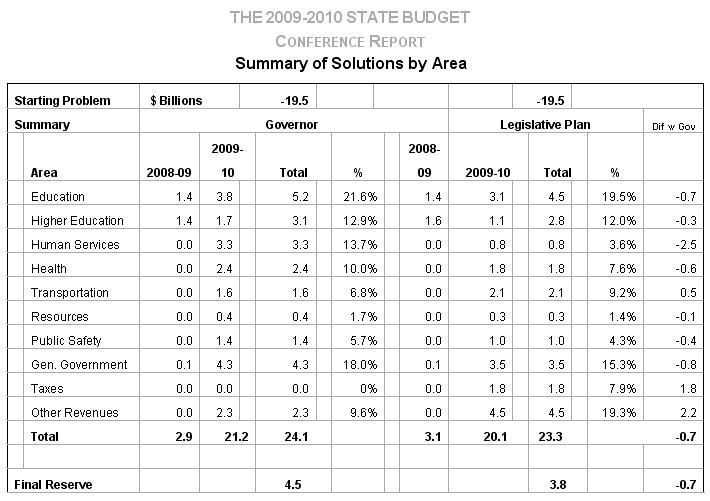
The Assembly Budget Committee released an analysis of the budget plan crafted by the Conference Committee. A full copy of the full report is available online at the Budget Committee's Website. For a brief side-by-side comparison of our budget plan with the governor's, please refer to this chart.
Tuesday, June 16, 2009
Conference Committee Closes Budget Gap with Cuts and Revenues
After 17 days of public testimony and hearings to close our state’s $24 billion deficit, the Conference Committee has taken action on all budget proposals. As a result of our actions, the conferees have voted to create a budget that includes both cuts and new revenues.
We made some difficult and painful cuts to the budget that we would never consider if our state’s financial circumstances were better. But with the need for state services rising each day, fairness demands that reject the governor’s proposals to eliminate the safety net. In order to maintain the safety net and a minimum of other services Californians value, revenues must be on the table.
Today in Conference Committee, we unveiled and approved new revenue proposals to obviate the need for further cuts. These proposals do not impact most Californians. But they help prevent cuts that would impact most Californians. This is the simple logic at work.
Californians expect their schools to be good, a safety net to be available to the needy, a college education to be affordable for working families, their air and water to be clean, and their parks to be open and kept up. In order to meet their expectations, we must to pursue new revenues. Today, for the greater good, we approved two new tax proposals that won’t impact most Californians.
Establishing a 9.9 percent tax on oil extracted from California would generate $830 million in FY 2009-2010 and $1.1 billion in future years. This precise proposal was part of the governor’s budget proposals last year. Increasing the excise tax on cigarettes by $1.50 per pack generates $1 billion in FY 2009-2010.
Tax increases require a 2/3 vote. Absent the pursuit of new revenues, wider and deeper cuts will be required. Getting new revenues requires a mere 6 Republican votes: 2 in the Senate and 4 in the Assembly. It is undemocratic that the votes of 6 Republicans can veto the votes of 75 Democrats.
Republican legislators and the governor claim the outcome of the May 19 special election is a referendum on new taxes. But the voters also rejected propositions that would have cut social programs for which voters approved new taxes. Therefore, it would be inappropriate to suggest anything other than a balanced approach is what the voters expect to our budget crisis.
While a complete run down of all actions made by the Conference Committee will be made available tomorrow by the Assembly Budget Committee and posted on this blog, here is a sample of the actions taken by the conferees today.
• Education – Adopted $5.5 billion in Proposition 98 reductions for K-14 education, including $4.5 billion to K-12 education. Provided $496 million in Proposition 98 funding for Home-to-School Transportation
• Higher Education – Adopted the level of General Fund reductions proposed by the governor for the UC and CSU system, $1.44 billion in 2008-2009 and $533 million in 2009-2010. The intent is to backfill these amounts with federal funds. Restored full funding for CalGrants. Retained academic preparation programs at UC/CSU.
• Corrections – Adopted a compromise proposal which reduces spending by $787 million, including $402 million in savings by restricting wobbler prosecutions to misdemeanors, targeted commutations, and alternative custody options. We also cut rehabilitation programs by $175 million instead of eliminating them as was proposed by the governor.
• Human Services – Rejected the governor’s proposal to eliminate Multipurpose Senior Services Program and minimized the reductions to other Aging programs. Adopted a compromise proposal restricting in-home supportive services. Domestic services will be provided to individuals FI scores of 4 and above, with critical exemptions for the most fragile recipients.
We made some difficult and painful cuts to the budget that we would never consider if our state’s financial circumstances were better. But with the need for state services rising each day, fairness demands that reject the governor’s proposals to eliminate the safety net. In order to maintain the safety net and a minimum of other services Californians value, revenues must be on the table.
Today in Conference Committee, we unveiled and approved new revenue proposals to obviate the need for further cuts. These proposals do not impact most Californians. But they help prevent cuts that would impact most Californians. This is the simple logic at work.
Californians expect their schools to be good, a safety net to be available to the needy, a college education to be affordable for working families, their air and water to be clean, and their parks to be open and kept up. In order to meet their expectations, we must to pursue new revenues. Today, for the greater good, we approved two new tax proposals that won’t impact most Californians.
Establishing a 9.9 percent tax on oil extracted from California would generate $830 million in FY 2009-2010 and $1.1 billion in future years. This precise proposal was part of the governor’s budget proposals last year. Increasing the excise tax on cigarettes by $1.50 per pack generates $1 billion in FY 2009-2010.
Tax increases require a 2/3 vote. Absent the pursuit of new revenues, wider and deeper cuts will be required. Getting new revenues requires a mere 6 Republican votes: 2 in the Senate and 4 in the Assembly. It is undemocratic that the votes of 6 Republicans can veto the votes of 75 Democrats.
Republican legislators and the governor claim the outcome of the May 19 special election is a referendum on new taxes. But the voters also rejected propositions that would have cut social programs for which voters approved new taxes. Therefore, it would be inappropriate to suggest anything other than a balanced approach is what the voters expect to our budget crisis.
While a complete run down of all actions made by the Conference Committee will be made available tomorrow by the Assembly Budget Committee and posted on this blog, here is a sample of the actions taken by the conferees today.
• Education – Adopted $5.5 billion in Proposition 98 reductions for K-14 education, including $4.5 billion to K-12 education. Provided $496 million in Proposition 98 funding for Home-to-School Transportation
• Higher Education – Adopted the level of General Fund reductions proposed by the governor for the UC and CSU system, $1.44 billion in 2008-2009 and $533 million in 2009-2010. The intent is to backfill these amounts with federal funds. Restored full funding for CalGrants. Retained academic preparation programs at UC/CSU.
• Corrections – Adopted a compromise proposal which reduces spending by $787 million, including $402 million in savings by restricting wobbler prosecutions to misdemeanors, targeted commutations, and alternative custody options. We also cut rehabilitation programs by $175 million instead of eliminating them as was proposed by the governor.
• Human Services – Rejected the governor’s proposal to eliminate Multipurpose Senior Services Program and minimized the reductions to other Aging programs. Adopted a compromise proposal restricting in-home supportive services. Domestic services will be provided to individuals FI scores of 4 and above, with critical exemptions for the most fragile recipients.
Monday, June 15, 2009
Budgeting Responsibly and Openly
It takes time to craft a responsible budget. Is a governor who turned in the final details of his May 14 Revise Budget on June 12 in a position to lecture the Legislature on budget deadlines?
Yes, the Legislature needs to act quickly. But the Conference Committee is balancing this need with transparent deliberations about the budget options that lay ahead so that the public can monitor our decisions. I am committed to this as a responsible course of action, which takes a little time. But it doesn’t take a lot of time. Conference Committee is diligently working to conclude in the coming days.
The governor has politicized our commitment to an open budget process in saying that he would shut down the state on July 1 if the Legislature does not act quickly. Then, he revoked the Controller's authority to issue RAWs for short term money management. But every year the state borrows billions of dollars in short term capital during the summer months to meet cash flow needs. Surely the governor’s announcement didn't improve the market’s perception of California as an investment destination.
Today, the Conference Committee began the second run through the budget. Here are some of the highlights of today’s actions.
• Local Government – Rejected the governor’s proposal to borrow nearly $2 billion from local government through the suspension of Proposition 1A.
• Natural Resources – Approved the governor’s proposal to eliminate all General Fund support for the state park system, about $110 million. Approved a $15 vehicle license fee to fund state parks while providing free public access to most state parks.
• Health – Rejected the governor’s proposal to eliminate Healthy Families and approved a $70 million cut, which would create a waiting list for the program unless other funds are identified. Rejected the governor’s proposals to eliminate funding for HIV/AIDS prevention and education, HIV/AIDS testing, home care and counseling services to those living with AIDS. Rejected the governor’s proposed $12.3 million cut to the AIDS Drug Assistance Program, which provides low and moderate income people with access to retroviral therapies at subsidized prices. Adopted a compromise proposal cutting a combined $8 million from all HIV/AIDS programs.
• Transportation – Approved governor’s proposal to use $336 million in “spillover” funds from gas excise tax for General Fund relief. Approved governor’s proposal for $139 million in Proposition 1A funding for the High Speed Rail Authority.
Check out my new video about the challenges we face in order to craft a responsible budget.
http://www.youtube.com/watch?v=Ca3cZGWki04
Yes, the Legislature needs to act quickly. But the Conference Committee is balancing this need with transparent deliberations about the budget options that lay ahead so that the public can monitor our decisions. I am committed to this as a responsible course of action, which takes a little time. But it doesn’t take a lot of time. Conference Committee is diligently working to conclude in the coming days.
The governor has politicized our commitment to an open budget process in saying that he would shut down the state on July 1 if the Legislature does not act quickly. Then, he revoked the Controller's authority to issue RAWs for short term money management. But every year the state borrows billions of dollars in short term capital during the summer months to meet cash flow needs. Surely the governor’s announcement didn't improve the market’s perception of California as an investment destination.
Today, the Conference Committee began the second run through the budget. Here are some of the highlights of today’s actions.
• Local Government – Rejected the governor’s proposal to borrow nearly $2 billion from local government through the suspension of Proposition 1A.
• Natural Resources – Approved the governor’s proposal to eliminate all General Fund support for the state park system, about $110 million. Approved a $15 vehicle license fee to fund state parks while providing free public access to most state parks.
• Health – Rejected the governor’s proposal to eliminate Healthy Families and approved a $70 million cut, which would create a waiting list for the program unless other funds are identified. Rejected the governor’s proposals to eliminate funding for HIV/AIDS prevention and education, HIV/AIDS testing, home care and counseling services to those living with AIDS. Rejected the governor’s proposed $12.3 million cut to the AIDS Drug Assistance Program, which provides low and moderate income people with access to retroviral therapies at subsidized prices. Adopted a compromise proposal cutting a combined $8 million from all HIV/AIDS programs.
• Transportation – Approved governor’s proposal to use $336 million in “spillover” funds from gas excise tax for General Fund relief. Approved governor’s proposal for $139 million in Proposition 1A funding for the High Speed Rail Authority.
Check out my new video about the challenges we face in order to craft a responsible budget.
http://www.youtube.com/watch?v=Ca3cZGWki04
Friday, June 12, 2009
Conferees Complete First Pass Through of Budget
Day 15 of Conference Committee completed our initial review of budget proposals from the governor and the Legislative Analyst’s Office.
Some highlights of our actions are as follows:
• Transportation – Approved the governor’s proposal to take $986 million from local streets and roads funding for transportation-related bond debt retirement, and loaned$135 million in highway money to the General Fund. Rejected an LAO proposal to partially suspend Proposition 42 funds and redirect $1.152 billion to the General Fund.
• Revenues and Taxes – Approved a new program to go after tax cheats through the Financial Records Match project. Approved the governor’s proposal to increase the June quarterly estimated personal and corporate tax payments from 30 to 40 percent for a revenue acceleration of $610 million. Approved the governor’s proposal to increase withholding from personal income tax by 10 percent, starting October 2009, for a revenue acceleration of $1.7 billion.
• Resources – Approved the LAO’s proposal to reduce Marine Life Protection Act funding from the General Fund and backfilled it with funds from Proposition 84.
• General Government – Approved the governor’s proposal for cash solutions allowing the Pooled Money Investment Board to invest in federally insured Negotiable Order of Withdrawal accounts.
Our goal is to close the budget items early next week in order to put a budget on the floor shortly thereafter. However, I continue to be stunned by the governor’s failure to work with the Legislature to solve this historic budget crisis. Both parties represented on the Conference Committee are united in their determination to craft a budget plan in a deliberative, transparent way. All of us are frustrated with the governor. It is ironic how the governor has brought the Legislature together.
Without any heads up, in the middle of our deliberations today, we received considerable new details affecting the governor’s proposal to borrow nearly $2 billion in Proposition 1A funds affecting every local government in California. This occurred literally minutes before this particular item came up in the committee. While I was prepared to reject the governor’s initial proposal, the new details deserve consideration. But this simply delays our ability to conclude the committee’s business.
The governor’s tardiness makes it nearly impossible to complete our business in a timely and responsible manner. He has threatened to shut down the state unless he gets his way. At the same time, he has removed the State Controller’s ability to protect the state from this shut down. This is showmanship, not statesmanship.
For further information about Conference Committee agendas and summations of our actions, please visit the Assembly Budget Committee website at http://www.asm.ca.gov/budget and click the “Conference Agenda” tab.
Some highlights of our actions are as follows:
• Transportation – Approved the governor’s proposal to take $986 million from local streets and roads funding for transportation-related bond debt retirement, and loaned$135 million in highway money to the General Fund. Rejected an LAO proposal to partially suspend Proposition 42 funds and redirect $1.152 billion to the General Fund.
• Revenues and Taxes – Approved a new program to go after tax cheats through the Financial Records Match project. Approved the governor’s proposal to increase the June quarterly estimated personal and corporate tax payments from 30 to 40 percent for a revenue acceleration of $610 million. Approved the governor’s proposal to increase withholding from personal income tax by 10 percent, starting October 2009, for a revenue acceleration of $1.7 billion.
• Resources – Approved the LAO’s proposal to reduce Marine Life Protection Act funding from the General Fund and backfilled it with funds from Proposition 84.
• General Government – Approved the governor’s proposal for cash solutions allowing the Pooled Money Investment Board to invest in federally insured Negotiable Order of Withdrawal accounts.
Our goal is to close the budget items early next week in order to put a budget on the floor shortly thereafter. However, I continue to be stunned by the governor’s failure to work with the Legislature to solve this historic budget crisis. Both parties represented on the Conference Committee are united in their determination to craft a budget plan in a deliberative, transparent way. All of us are frustrated with the governor. It is ironic how the governor has brought the Legislature together.
Without any heads up, in the middle of our deliberations today, we received considerable new details affecting the governor’s proposal to borrow nearly $2 billion in Proposition 1A funds affecting every local government in California. This occurred literally minutes before this particular item came up in the committee. While I was prepared to reject the governor’s initial proposal, the new details deserve consideration. But this simply delays our ability to conclude the committee’s business.
The governor’s tardiness makes it nearly impossible to complete our business in a timely and responsible manner. He has threatened to shut down the state unless he gets his way. At the same time, he has removed the State Controller’s ability to protect the state from this shut down. This is showmanship, not statesmanship.
For further information about Conference Committee agendas and summations of our actions, please visit the Assembly Budget Committee website at http://www.asm.ca.gov/budget and click the “Conference Agenda” tab.
Next 10 Updates its Annual “Budget Challenge”
Next 10 has been providing this do-it-yourself tool on their website for 5 years where you can solve the state’s budget problem. It allows you to pick the options for cuts, revenues, and borrowing. Follow the link below and try for yourself.
http://next10.org/challenge
http://next10.org/challenge
Thursday, June 11, 2009
Governor Threatens to Terminate California
Changing the subject never makes the real problem go away. Unfortunately for California, the governor has reduced our fiscal crisis to a theater of the absurd. If the governor doesn’t change course, it’s the people who will lose.
At any moment, I am convinced that the voice of Rod Serling will announce that the State of California is caught “in the Twilight Zone.” That is where the governor is leading us.
If there were ever a time when the governor and the Legislature need to work together, it’s right now. How else can we quickly and responsibly solve our state’s budget crisis?
Instead, the governor is making things worse with late, half-baked budget proposals. The governor has had 4 different May Revision budget proposals, the final details of which he finally managed to get to the Legislature late at night two days ago. That particular proposal affects the financial well being of every city and county in California.
Then, today, the governor initiated a high-stakes game of chicken with the Legislature. He challenged us to adopt his proposals or he’s prepared to shut down the state. On top of this bizarre behavior, he sent a letter to the State Controller stating that he refuses to issue a Revenue Anticipation Warrant (RAW) to “paper over our current budget shortfall.” Well, the Legislature objected to having a RAW within our budget plan months ago. So glad you could join us, governor!
The Legislature is committed to having a budget this month. In fact, Conference Committee will conclude its business early next week and have a budget put on the floor. And, we’ll do that despite the governor’s antics.
At any moment, I am convinced that the voice of Rod Serling will announce that the State of California is caught “in the Twilight Zone.” That is where the governor is leading us.
If there were ever a time when the governor and the Legislature need to work together, it’s right now. How else can we quickly and responsibly solve our state’s budget crisis?
Instead, the governor is making things worse with late, half-baked budget proposals. The governor has had 4 different May Revision budget proposals, the final details of which he finally managed to get to the Legislature late at night two days ago. That particular proposal affects the financial well being of every city and county in California.
Then, today, the governor initiated a high-stakes game of chicken with the Legislature. He challenged us to adopt his proposals or he’s prepared to shut down the state. On top of this bizarre behavior, he sent a letter to the State Controller stating that he refuses to issue a Revenue Anticipation Warrant (RAW) to “paper over our current budget shortfall.” Well, the Legislature objected to having a RAW within our budget plan months ago. So glad you could join us, governor!
The Legislature is committed to having a budget this month. In fact, Conference Committee will conclude its business early next week and have a budget put on the floor. And, we’ll do that despite the governor’s antics.
Wednesday, June 10, 2009
The Human Cost of Cuts – Linnea’s Story
People with HIV or AIDS and their providers rallied at the State Capitol today to oppose the governor’s proposed budget cuts to a variety or programs which literally keep people alive. During the public comment period of Conference Committee, people told us about the importance of these programs in their daily lives. The testimony below from a brave 24 year old woman born with HIV was especially poignant.
Conference Committee Actions on Human Services and Public Safety
Day 13 of Conference Committee completed our initial actions on the budget relating to human services and began our actions relating to public safety.
Most of the governor’s proposals in the human services budget are crying out for alternatives. Consequently, many items remain open in this area of the Conference Committee agenda. Eliminating the Multipurpose Senior Services Program, the Linkages Program, and adult day health care have huge human costs. But the conferees did reject the governor’s proposal to eliminate CalWORKS. That is a line that California cannot cross.
In public safety, we took many actions affecting our state’s court system. As a lawyer of over twenty years, I firmly believe in the importance of maintaining a fair, open, and efficient judicial system. That is why the governor’s proposal to cut General Fund support for our trial courts by 10 percent– about $168 million – must be handled with great care. The conferees approved this proposal today but with the commitment to continue working on implementation issues to assure the functioning of our courts.
Other actions adopted by Conference Committee today relating to public safety include:
• Approving the governor’s proposal to charge local law enforcement agencies lab fees for forensic services for a budget savings of $20 million;
• Approving the LAO’s proposal to cut the Bureau for Narcotics Enforcement at the Department of Justice by $20 million; and
• Rejecting the governor’s proposal to implement electronic court reporting.
The conference committee agendas for human services and public safety can be found online at the Assembly Budget Committee website at http://www.asm.ca.gov/budget under the “Conference Agenda” tab.
Most of the governor’s proposals in the human services budget are crying out for alternatives. Consequently, many items remain open in this area of the Conference Committee agenda. Eliminating the Multipurpose Senior Services Program, the Linkages Program, and adult day health care have huge human costs. But the conferees did reject the governor’s proposal to eliminate CalWORKS. That is a line that California cannot cross.
In public safety, we took many actions affecting our state’s court system. As a lawyer of over twenty years, I firmly believe in the importance of maintaining a fair, open, and efficient judicial system. That is why the governor’s proposal to cut General Fund support for our trial courts by 10 percent– about $168 million – must be handled with great care. The conferees approved this proposal today but with the commitment to continue working on implementation issues to assure the functioning of our courts.
Other actions adopted by Conference Committee today relating to public safety include:
• Approving the governor’s proposal to charge local law enforcement agencies lab fees for forensic services for a budget savings of $20 million;
• Approving the LAO’s proposal to cut the Bureau for Narcotics Enforcement at the Department of Justice by $20 million; and
• Rejecting the governor’s proposal to implement electronic court reporting.
The conference committee agendas for human services and public safety can be found online at the Assembly Budget Committee website at http://www.asm.ca.gov/budget under the “Conference Agenda” tab.
Help the Legislature Help You, Governor
When the governor addressed a special joint session of the Legislature last week, he spoke with a cooperative tone and noted the urgency to take quick action on California’s budget challenges to avert a fiscal meltdown. But after this encouraging start, the governor’s follow up has been lackluster.
At that time, the governor said:
“I have faith in all of you [members of the Legislature]. I have faith in our ability to once again come together for the good of our state. Let’s move forward and put California back on the path to prosperity.”
But then, the governor upped the ante, saying he wants the Legislature to vote on a budget by June 15.
Unfortunately, the governor is not helping the Legislature meet the demands of his ambitious timetable. We have been frustrated in our efforts to get specifics from the governor about his budget proposals to close our $24 billion deficit.
For weeks we have been asking “Where’s the beef?” in Conference Committee. Budget decisions of this magnitude are not to be taken lightly or on faith. The devil is in the details and we are still asking for them. Just last night, we finally received the details about some of the governor’s big ticket budget proposals – such as taking nearly $2 billion from local government and saving $1 billion through getting flexibility from the feds in administering Medi-Cal. Yet, the June 15 deadline is only days away.
What has the governor been busy doing? Promoting the new $55,000 electric Hummer. The governor even wrote about it on Twitter..
As we bring closure to the Conference Committee process next week and attempt to meet the governor’s request for urgent action on the budget, I hope he will provide us with the information we need to succeed.
At that time, the governor said:
“I have faith in all of you [members of the Legislature]. I have faith in our ability to once again come together for the good of our state. Let’s move forward and put California back on the path to prosperity.”
But then, the governor upped the ante, saying he wants the Legislature to vote on a budget by June 15.
Unfortunately, the governor is not helping the Legislature meet the demands of his ambitious timetable. We have been frustrated in our efforts to get specifics from the governor about his budget proposals to close our $24 billion deficit.
For weeks we have been asking “Where’s the beef?” in Conference Committee. Budget decisions of this magnitude are not to be taken lightly or on faith. The devil is in the details and we are still asking for them. Just last night, we finally received the details about some of the governor’s big ticket budget proposals – such as taking nearly $2 billion from local government and saving $1 billion through getting flexibility from the feds in administering Medi-Cal. Yet, the June 15 deadline is only days away.
What has the governor been busy doing? Promoting the new $55,000 electric Hummer. The governor even wrote about it on Twitter..
As we bring closure to the Conference Committee process next week and attempt to meet the governor’s request for urgent action on the budget, I hope he will provide us with the information we need to succeed.
Tuesday, June 9, 2009
Conference Committee Actions on Health - Continued
Day 12 of the Conference Committee completed our initial actions on the health budget. We also began on the budget relating to human services.
Some of the program eliminations and reductions proposed in the governor’s revised budget within health and human services will end up costing the state more in the long run and could endanger the lives of the most vulnerable people in the state. Consider these examples:
· Eliminating health care services for the poor will undermine the readiness of our emergency rooms across the state because more Californians will use them for medical care; and
· Restricting in-home supportive services eligibility from the current level of nearly 430,000 clients will increase California’s reliance on nursing home care at significantly higher cost.
As we move forward with making more decisions, the challenge is finding a way to make cuts that are not penny wise but pound foolish. Some cuts will result in a loss of matching federal dollars, which results in a larger economic impact of jobs and commerce lost in local communities. Many cuts disproportionately impact women, children and seniors in multiple ways. Conferees are grappling with these challenges as we try to find the cuts that result in the least amount of harm to individuals needing services and our state’s well being overall.
Here is a sample of the decisions made by the Conference Committee today. The impacts are a mixed bag of good and bad:
· Women’s Health – Approved $13.8 million for breast cancer early detection for uninsured Californians. Rejected the governor’s proposal to eliminate all $20.4 million in funding for domestic violence shelters in favor of a 20 percent reduction.
· Children’s Dental Care – Approved the governor’s proposal to save $2.9 million by suspending dental disease program, serving 300,000 school kids in 30 counties
· Mental Health – Approved governor’s proposal to eliminate mental health services other than federally required inpatient hospitalization and medication services for a savings of $113 million.
Overall, the Conference Committee has now taken actions which amount to approximately $800 million in cuts or budget savings within the health budget.
The conference committee agendas for health and human services can be found online at the Assembly Budget Committee website at http://www.asm.ca.gov/budget under the “Conference Agenda” tab.
Some of the program eliminations and reductions proposed in the governor’s revised budget within health and human services will end up costing the state more in the long run and could endanger the lives of the most vulnerable people in the state. Consider these examples:
· Eliminating health care services for the poor will undermine the readiness of our emergency rooms across the state because more Californians will use them for medical care; and
· Restricting in-home supportive services eligibility from the current level of nearly 430,000 clients will increase California’s reliance on nursing home care at significantly higher cost.
As we move forward with making more decisions, the challenge is finding a way to make cuts that are not penny wise but pound foolish. Some cuts will result in a loss of matching federal dollars, which results in a larger economic impact of jobs and commerce lost in local communities. Many cuts disproportionately impact women, children and seniors in multiple ways. Conferees are grappling with these challenges as we try to find the cuts that result in the least amount of harm to individuals needing services and our state’s well being overall.
Here is a sample of the decisions made by the Conference Committee today. The impacts are a mixed bag of good and bad:
· Women’s Health – Approved $13.8 million for breast cancer early detection for uninsured Californians. Rejected the governor’s proposal to eliminate all $20.4 million in funding for domestic violence shelters in favor of a 20 percent reduction.
· Children’s Dental Care – Approved the governor’s proposal to save $2.9 million by suspending dental disease program, serving 300,000 school kids in 30 counties
· Mental Health – Approved governor’s proposal to eliminate mental health services other than federally required inpatient hospitalization and medication services for a savings of $113 million.
Overall, the Conference Committee has now taken actions which amount to approximately $800 million in cuts or budget savings within the health budget.
The conference committee agendas for health and human services can be found online at the Assembly Budget Committee website at http://www.asm.ca.gov/budget under the “Conference Agenda” tab.
Try Closing the Budget Gap
All of us have ideas and priorities about how the state budget should work. Now you can put your views to work and see how you would close California’s $24 billion budget gap. The Los Angeles Times has created an interactive application which includes major proposals from the Governor and the Legislative Analyst’s Office as well as new revenue ideas often discussed. You can find the application at: http://www.latimes.com/news/local/la-statebudget-fl,0,95571.htmlstory.
Monday, June 8, 2009
Conference Committee Actions on Health
Day 11 of the Conference Committee focused on programs and services within our health budget.
Who consumes state health program services in California? Everyone. I can’t think of a parent who hasn’t called a Poison Control Center hotline in an absolute panic. However, in overall dollar terms, most health programs and services are consumed by seniors, children, and the poor.
As we move forward to balance our state’s $24 billion budget deficit, we will need to make cuts to health programs since they – along with human services programs – comprise the second largest part of our budget. But we need to avoid those cuts that literally mean the difference between life and death. We also need to minimize the secondary impacts of cuts on our already broken health care system in California.
Scaling back or eliminating some of our state health programs occurs within the context of many Californians already living without other outlets for health care services. Over 6 million Californians, including over 800,000 children, are uninsured. This is more than any other state in the nation and more than the population of 38 states. Most of California’s uninsured work in full-time jobs.
Against this backdrop, the Conference Committee rejected some of the governor’s proposals. Consider these relating to women’s health:
· Eliminating the Breast and Cervical Cancer Treatment Program (BCCTP) for low-income women;
· Eliminating BCCTP and postpartum care for undocumented women; and
· Reducing reimbursement rates for family planning services, for which the federal government provides a 9 to 1 match.
We also rejected the governor’s proposal to eliminate the special dialysis program, which has been in place since the early 1970s.
The Conference Committee took many actions which amount to approximately $400 million in cuts or budget savings, which include:
· Prescription Drugs - $22.5 million by reducing Medi-Cal reimbursements to pharmacies to the lowest competitive rate that is routinely available to other drug plans or segments of the public. $1.5 million in savings through the therapeutic category review of anti-psychotic drugs dispensed through Medi-Cal. $1.25 million in savings through mandating HIV/AIDS and cancer drug rebate use.
· Technical Adjustments – $26.9 million in savings by accounting for eligibility changes within Medi-Cal. $6.6 million in savings by changing how California conforms to the federal Children’s Health Insurance Program Reauthorization Act of 2009.
· Unspecified Budget Reductions - $323 million cut from local assistance to Medi-Cal. $14.3 million cut to state operations of Medi-Cal.
We also raised the Quality Assurance Fee paid by nursing homes which will generate $18.3 million to offset General Fund support.
The conference committee agenda for health can be found online at the Assembly Budget Committee website at http://www.asm.ca.gov/budget under the “Conference Agenda” tab.
Who consumes state health program services in California? Everyone. I can’t think of a parent who hasn’t called a Poison Control Center hotline in an absolute panic. However, in overall dollar terms, most health programs and services are consumed by seniors, children, and the poor.
As we move forward to balance our state’s $24 billion budget deficit, we will need to make cuts to health programs since they – along with human services programs – comprise the second largest part of our budget. But we need to avoid those cuts that literally mean the difference between life and death. We also need to minimize the secondary impacts of cuts on our already broken health care system in California.
Scaling back or eliminating some of our state health programs occurs within the context of many Californians already living without other outlets for health care services. Over 6 million Californians, including over 800,000 children, are uninsured. This is more than any other state in the nation and more than the population of 38 states. Most of California’s uninsured work in full-time jobs.
Against this backdrop, the Conference Committee rejected some of the governor’s proposals. Consider these relating to women’s health:
· Eliminating the Breast and Cervical Cancer Treatment Program (BCCTP) for low-income women;
· Eliminating BCCTP and postpartum care for undocumented women; and
· Reducing reimbursement rates for family planning services, for which the federal government provides a 9 to 1 match.
We also rejected the governor’s proposal to eliminate the special dialysis program, which has been in place since the early 1970s.
The Conference Committee took many actions which amount to approximately $400 million in cuts or budget savings, which include:
· Prescription Drugs - $22.5 million by reducing Medi-Cal reimbursements to pharmacies to the lowest competitive rate that is routinely available to other drug plans or segments of the public. $1.5 million in savings through the therapeutic category review of anti-psychotic drugs dispensed through Medi-Cal. $1.25 million in savings through mandating HIV/AIDS and cancer drug rebate use.
· Technical Adjustments – $26.9 million in savings by accounting for eligibility changes within Medi-Cal. $6.6 million in savings by changing how California conforms to the federal Children’s Health Insurance Program Reauthorization Act of 2009.
· Unspecified Budget Reductions - $323 million cut from local assistance to Medi-Cal. $14.3 million cut to state operations of Medi-Cal.
We also raised the Quality Assurance Fee paid by nursing homes which will generate $18.3 million to offset General Fund support.
The conference committee agenda for health can be found online at the Assembly Budget Committee website at http://www.asm.ca.gov/budget under the “Conference Agenda” tab.
Friday, June 5, 2009
Conference Committee Actions on Higher Education and Child Care
Day 10 of the Conference Committee focused on higher education and child care. We discussed items such as:
- $1.969 billion in cuts to the CSU/UC system;
- $935 million in cuts from community colleges;
- Eliminating funding for child care for people enrolled in CalWORKS; and
- Eliminating funding for student academic preparation programs.
We chose to not yet act on these proposals because the depth of the cuts we will have to absorb is shaped by the overall structure of the budget that we are putting together. Many of these programs proposed to be cut or eliminated make our society more inclusive and help disadvantaged communities have access to education. Do we want a state in which only the wealthy can go to college? That's not my vision of our collective future.
There was one proposal of the governor's that the Committee soundly rejected - to eliminate the CalGrant entitlements and new awards that helps hundreds of thousands of students go to college every year.
At the same time we are discussing cutting community colleges, we are seeing a fundamental, de facto shift in the role community colleges play. UC's and CSU's are turning away freshmen applicants who are qualified and in a more affluent time would have been admitted. The message being given to these students is: spend your first two years at a community college and then transfer to a UC or CSU as an upper division student. If we cut back access to community colleges, however, we turn away thousands of students who seek a college education. Thus, the committee is struggling with how to absorb cuts while still accommodating these students.
We also approved approximately 30 items relating to the budget, all with a unanimous vote. A sample of these actions includes:
-Technical budgeting adjustments to the CSU/UC system, accounting for the failure of initiatives on the May special election to pass, notably Proposition 1C (Lottery Securitization);
-Adding reimbursement authority to accept hundreds of millions of dollars in federal stimulus funds for higher education.
In other words, we acted on the items detailed pages 44-46 of the agenda. A full copy of today’s agenda is available on the Assembly Budget Committee website at http://asm.ca.gov/budget under the “Conference Agenda” tab.
SCHEDULE UPDATE:
Next week we will begin our discussion on the governor's proposal to eliminate CalWORKS and Health Families. The Committee will meet Monday at 2:00.
- $1.969 billion in cuts to the CSU/UC system;
- $935 million in cuts from community colleges;
- Eliminating funding for child care for people enrolled in CalWORKS; and
- Eliminating funding for student academic preparation programs.
We chose to not yet act on these proposals because the depth of the cuts we will have to absorb is shaped by the overall structure of the budget that we are putting together. Many of these programs proposed to be cut or eliminated make our society more inclusive and help disadvantaged communities have access to education. Do we want a state in which only the wealthy can go to college? That's not my vision of our collective future.
There was one proposal of the governor's that the Committee soundly rejected - to eliminate the CalGrant entitlements and new awards that helps hundreds of thousands of students go to college every year.
At the same time we are discussing cutting community colleges, we are seeing a fundamental, de facto shift in the role community colleges play. UC's and CSU's are turning away freshmen applicants who are qualified and in a more affluent time would have been admitted. The message being given to these students is: spend your first two years at a community college and then transfer to a UC or CSU as an upper division student. If we cut back access to community colleges, however, we turn away thousands of students who seek a college education. Thus, the committee is struggling with how to absorb cuts while still accommodating these students.
We also approved approximately 30 items relating to the budget, all with a unanimous vote. A sample of these actions includes:
-Technical budgeting adjustments to the CSU/UC system, accounting for the failure of initiatives on the May special election to pass, notably Proposition 1C (Lottery Securitization);
-Adding reimbursement authority to accept hundreds of millions of dollars in federal stimulus funds for higher education.
In other words, we acted on the items detailed pages 44-46 of the agenda. A full copy of today’s agenda is available on the Assembly Budget Committee website at http://asm.ca.gov/budget under the “Conference Agenda” tab.
SCHEDULE UPDATE:
Next week we will begin our discussion on the governor's proposal to eliminate CalWORKS and Health Families. The Committee will meet Monday at 2:00.
Conference Committee Actions on K-12 Education
Day 9 of the Conference Committee focused on K-12 education. We discussed many items on our lengthy agenda which lists 24 pages of budget proposals currently under consideration, such as:
· Cutting nearly $3.5 billion in K-12 revenue limit funding;
· Eliminating special funds for student transportation;
· Suspending most K-14 education mandates; and
· Giving school districts the discretion to shorten the school year by 7.5 days.
What would these proposals mean? California drops towards the bottom of states in providing resources to education. Children in rural communities have a harder time getting to school because school busses may stop running. And, our schools have less time to educate students and put them on a path to succeed in our increasingly competitive global economy.
We also approved numerous items relating to the K-12 education budget, most with a unanimous vote. A sample of these actions includes:
· $2.7 million shifted from the Teacher Credentials Fund to the General Fund; and
· Making technical adjustments of federal funds in budget, such as:
· $1.13 million decrease from health and tobacco prevention education for students;
· $9.4 million in augmentations for local assistance to child nutrition programs; and
· $2.3 million increase to Safe and Drug Free Schools Program.
In other words, we acted on the items detailed on pages 12, and 20-30 of the agenda. A full copy of the agenda is available on the Assembly Budget Committee website at http://asm.ca.gov/budget under the “Conference Agenda” tab.
· Cutting nearly $3.5 billion in K-12 revenue limit funding;
· Eliminating special funds for student transportation;
· Suspending most K-14 education mandates; and
· Giving school districts the discretion to shorten the school year by 7.5 days.
What would these proposals mean? California drops towards the bottom of states in providing resources to education. Children in rural communities have a harder time getting to school because school busses may stop running. And, our schools have less time to educate students and put them on a path to succeed in our increasingly competitive global economy.
We also approved numerous items relating to the K-12 education budget, most with a unanimous vote. A sample of these actions includes:
· $2.7 million shifted from the Teacher Credentials Fund to the General Fund; and
· Making technical adjustments of federal funds in budget, such as:
· $1.13 million decrease from health and tobacco prevention education for students;
· $9.4 million in augmentations for local assistance to child nutrition programs; and
· $2.3 million increase to Safe and Drug Free Schools Program.
In other words, we acted on the items detailed on pages 12, and 20-30 of the agenda. A full copy of the agenda is available on the Assembly Budget Committee website at http://asm.ca.gov/budget under the “Conference Agenda” tab.
Wednesday, June 3, 2009
Conference Committee Actions on State Government Reorganization
Day 8 of the Conference Committee brought the end of the public comment period and the beginning of our taking concrete actions to address California’s budget challenges. Today’s actions focused on the reorganization of state government.
Today’s agenda had six items. These items and the actions taken by the Conference Committee were as follows.
1. Adopt the Governor's proposed Control Section 13.25 to allow DOF to make necessary budget adjustments to reflect reorganizations and consolidations, with the intent of achieving $50 million in savings.
a. Adopt the Control Section and score the savings.
b. The Legislature has already allowed the Governor's IT Reorganization Plan to go into effect, but recognizing the savings from that plan have not been incorporated in the budget, the Committee will score savings associated with that plan as well.
**CONFERENCE ACTION: Passed 10-0.
2. Restructure the Integrated Waste Management Board:
a. Eliminate the Department of Conservation, and the Department of Toxics Control, and consolidate their functions into the Integrated Waste Management Board.
b. Restructure the Integrated Waste Management Board as the Integrated Waste Management and Recycling Board.
c. Reduce the Board's membership, make the Board part time, and reduce salaries to be in line with other part-time boards.
**CONFERENCE ACTION: Refer to policy committee, passed 10-0.
3. Restructure the Unemployment Insurance Appeals Board
a. Restructure the Unemployment Insurance Appeals Board to make it a part time board, streamline functioning, and reduce board member salaries to be in line with other part-time boards.
**CONFERENCE ACTION: Refer to policy committee, passed 10-0.
4. Request Policy Committee's review, in addition to the Integrated Waste Management Board and the Unemployment Insurance Appeals Board, all full-time salaried boards and consider making them part-time. These include:
a. Agricultural Labor Relations Board
b. Air Resource Control Board
c. Energy Resources Conservation and Development Commission
d. Fair Political Practice Commission (chair is full-time only)
e. Gambling Control Commission
f. Occupational Safety & Health Appeals Board
g. Board of Parole Hearings
h. Public Employment Relations Board
i. Public Utilities Commission
j. Water Resources Control Board
k. Workers’ Compensation Appeals Board
**CONFERENCE ACTION: Refer to policy committee, passed 10-0.
5. Eliminate Agency Level of State Government
a. Eliminate state agencies, including the State and Consumer Services Agency, Business, Transportation and Housing Agency, Health and Human Services Agency, Resources Agency, Environmental Protection Agency, and the Labor and Workforce Agency.
i. Move the Secretary and any other vital positions to the Governor's office and/or other existing state departments.
ii. Have LAO report back to the Conference Committee and appropriate policy committee's on what programs and functions (and associated positions) should be maintained, and what entity can best perform those functions, as well as which duplicative positions should be eliminated.
b. Office of the Secretary of Education
i. Eliminate the Office of the Secretary of Education and move the Secretary position to the Governor's office.
c. Office of Planning and Research
i. Eliminate the Governor's Office of Planning and Research (OPR)
ii. Move the Director of the Office of Planning and Research to the Governor's Office.
iii. Have LAO report back to the Conference Committee and appropriate policy committee's on what programs and functions (and any associated positions) should be maintained, and what entity can best perform those functions.
**CONFERENCE ACTION: Passed 10-0, with a request for input from the Legislative Analyst’s Office on implementation details.
6. Refer the remaining proposals made by the Governor and LAO to the appropriate Policy Committee's for review and request that they report back to the Conference Committee on any proposals that appear feasible and appropriate.
**CONFERENCE ACTION: Passed 10-0.
Today’s agenda had six items. These items and the actions taken by the Conference Committee were as follows.
1. Adopt the Governor's proposed Control Section 13.25 to allow DOF to make necessary budget adjustments to reflect reorganizations and consolidations, with the intent of achieving $50 million in savings.
a. Adopt the Control Section and score the savings.
b. The Legislature has already allowed the Governor's IT Reorganization Plan to go into effect, but recognizing the savings from that plan have not been incorporated in the budget, the Committee will score savings associated with that plan as well.
**CONFERENCE ACTION: Passed 10-0.
2. Restructure the Integrated Waste Management Board:
a. Eliminate the Department of Conservation, and the Department of Toxics Control, and consolidate their functions into the Integrated Waste Management Board.
b. Restructure the Integrated Waste Management Board as the Integrated Waste Management and Recycling Board.
c. Reduce the Board's membership, make the Board part time, and reduce salaries to be in line with other part-time boards.
**CONFERENCE ACTION: Refer to policy committee, passed 10-0.
3. Restructure the Unemployment Insurance Appeals Board
a. Restructure the Unemployment Insurance Appeals Board to make it a part time board, streamline functioning, and reduce board member salaries to be in line with other part-time boards.
**CONFERENCE ACTION: Refer to policy committee, passed 10-0.
4. Request Policy Committee's review, in addition to the Integrated Waste Management Board and the Unemployment Insurance Appeals Board, all full-time salaried boards and consider making them part-time. These include:
a. Agricultural Labor Relations Board
b. Air Resource Control Board
c. Energy Resources Conservation and Development Commission
d. Fair Political Practice Commission (chair is full-time only)
e. Gambling Control Commission
f. Occupational Safety & Health Appeals Board
g. Board of Parole Hearings
h. Public Employment Relations Board
i. Public Utilities Commission
j. Water Resources Control Board
k. Workers’ Compensation Appeals Board
**CONFERENCE ACTION: Refer to policy committee, passed 10-0.
5. Eliminate Agency Level of State Government
a. Eliminate state agencies, including the State and Consumer Services Agency, Business, Transportation and Housing Agency, Health and Human Services Agency, Resources Agency, Environmental Protection Agency, and the Labor and Workforce Agency.
i. Move the Secretary and any other vital positions to the Governor's office and/or other existing state departments.
ii. Have LAO report back to the Conference Committee and appropriate policy committee's on what programs and functions (and associated positions) should be maintained, and what entity can best perform those functions, as well as which duplicative positions should be eliminated.
b. Office of the Secretary of Education
i. Eliminate the Office of the Secretary of Education and move the Secretary position to the Governor's office.
c. Office of Planning and Research
i. Eliminate the Governor's Office of Planning and Research (OPR)
ii. Move the Director of the Office of Planning and Research to the Governor's Office.
iii. Have LAO report back to the Conference Committee and appropriate policy committee's on what programs and functions (and any associated positions) should be maintained, and what entity can best perform those functions.
**CONFERENCE ACTION: Passed 10-0, with a request for input from the Legislative Analyst’s Office on implementation details.
6. Refer the remaining proposals made by the Governor and LAO to the appropriate Policy Committee's for review and request that they report back to the Conference Committee on any proposals that appear feasible and appropriate.
**CONFERENCE ACTION: Passed 10-0.
Public Comment Period Concludes for the Conference Committee
No Conference Committee has ever devoted time to receiving public comment. This year, we took an historic step to open up the process and devoted some 30 hours of hearings to public comment about the governor’s May Revise budget proposals.
Many people – not professional lobbyists – made the trip to Sacramento to voice their concerns. Approximately 2,000 people provided written or verbal comments. Many others came just to witness the hearings. I was gratified by the diversity of people who took the initiative to get involved.
Some pundits called the public comment period a parade of pleas for mercy or a trail of tears. It is true that many individuals got emotional while testifying. But it is hard not to, considering some of the proposals the governor put on the table. Some individuals were jolted by the governor’s proposals to eliminate safety nets. These proposals impact the ability of millions – children, the disabled, seniors, and the poor – to survive. Other individuals were crushed with the prospect that their dreams of attending college were at risk because of the governor’s proposal to phase out CalGrants. Same goes for the dreams of those attending junior colleges who rely on Extended Opportunity Programs and Services (EOPS) that are facing cuts under the governor’s proposal.
This budget is about the people of California and the kind of state they want to call home. Public testimony humanized the budget process. It showed the impact of abstract cuts on the lives of Californians. Public comment also gave the public ownership in the budget process ahead. We received constructive input and ideas that will help us move forward with the difficult decisions that lay ahead.
Many people – not professional lobbyists – made the trip to Sacramento to voice their concerns. Approximately 2,000 people provided written or verbal comments. Many others came just to witness the hearings. I was gratified by the diversity of people who took the initiative to get involved.
Some pundits called the public comment period a parade of pleas for mercy or a trail of tears. It is true that many individuals got emotional while testifying. But it is hard not to, considering some of the proposals the governor put on the table. Some individuals were jolted by the governor’s proposals to eliminate safety nets. These proposals impact the ability of millions – children, the disabled, seniors, and the poor – to survive. Other individuals were crushed with the prospect that their dreams of attending college were at risk because of the governor’s proposal to phase out CalGrants. Same goes for the dreams of those attending junior colleges who rely on Extended Opportunity Programs and Services (EOPS) that are facing cuts under the governor’s proposal.
This budget is about the people of California and the kind of state they want to call home. Public testimony humanized the budget process. It showed the impact of abstract cuts on the lives of Californians. Public comment also gave the public ownership in the budget process ahead. We received constructive input and ideas that will help us move forward with the difficult decisions that lay ahead.
Tuesday, June 2, 2009
The Governor’s State Budget Address to the Legislature
The governor spoke to a special joint session of the Legislature today. I encourage you to read it. A copy is available at http://www.gov.ca.gov/press-release/12412/.
Overall, I could not help notice how he and I differ about what is at stake in the decisions that lay ahead.
The governor said:
“People come up to me all the time, pleading, ‘Governor, please don’t cut my program.’ They tell me how the cuts will affect them and their loved ones. I see the pain in their eyes and hear the fear in their voice. It’s an awful feeling. But we have no choice. Our wallet is empty. Our bank is closed. Our credit is dried up.”
When the governor went on to say that “we cannot make this budget just about cuts,” I was hoping to hear him talk about maintaining a minimum standard for the people of California. But he didn’t.
As the Chair of the Conference Committee, I have presided over numerous day-long hearings where the public has commented on the governor’s budget proposals – including the elimination of safety net programs at a time when the need is greatest. Consequently, I have developed a different perspective on the weight of the budget decisions we face.
One example of public testimony was especially poignant. A brave young woman – just 24 years old – came to tell the Conference Committee last Wednesday that she credits her survival to the state program that provides the expensive antiviral drugs she takes daily. With that HIV-prevention program facing the ax, she came to plead for life. Nearly in tears, she said, "If these cuts take place, you're not just cutting money from the program -- you're cutting my life. I choose to live. Please don't make me die. My choice is life."
Each budget cut has an impact, a human cost. And, under the governor’s budget proposals, many of these costs are paid by women, children, seniors, and the disabled.
Overall, I could not help notice how he and I differ about what is at stake in the decisions that lay ahead.
The governor said:
“People come up to me all the time, pleading, ‘Governor, please don’t cut my program.’ They tell me how the cuts will affect them and their loved ones. I see the pain in their eyes and hear the fear in their voice. It’s an awful feeling. But we have no choice. Our wallet is empty. Our bank is closed. Our credit is dried up.”
When the governor went on to say that “we cannot make this budget just about cuts,” I was hoping to hear him talk about maintaining a minimum standard for the people of California. But he didn’t.
As the Chair of the Conference Committee, I have presided over numerous day-long hearings where the public has commented on the governor’s budget proposals – including the elimination of safety net programs at a time when the need is greatest. Consequently, I have developed a different perspective on the weight of the budget decisions we face.
One example of public testimony was especially poignant. A brave young woman – just 24 years old – came to tell the Conference Committee last Wednesday that she credits her survival to the state program that provides the expensive antiviral drugs she takes daily. With that HIV-prevention program facing the ax, she came to plead for life. Nearly in tears, she said, "If these cuts take place, you're not just cutting money from the program -- you're cutting my life. I choose to live. Please don't make me die. My choice is life."
Each budget cut has an impact, a human cost. And, under the governor’s budget proposals, many of these costs are paid by women, children, seniors, and the disabled.
Public Safety, Natural Resources, and the Budget
Day 7 of the Conference Committee reviewed the Governor’s proposals affecting public safety and natural resources.
In public safety, the governor’s proposals primarily affect our state prisons system and our courts. Consider these proposals:
· $181 million in savings through commuting the sentences of undocumented immigrants in our state prison system and working with the federal government to deport them;
· $120.5 million in saving from releasing certain inmates one year early from prison and place them on house arrest with Global Positioning System monitoring for the remainder of their sentence;
· $99.9 million in savings by changing sentencing options for specific crimes that may be prosecuted either felonies or misdemeanors, making these offenses punishable by county jail and/or probation instead of state prison;
· $787.1 million in savings through eliminating funding for most rehabilitative services
· $168.6 million in cuts to our courts;
· $13 million in savings by phasing in electronic court reporting at a rate of 20% a year.
These cuts translate to real community impacts. The counties that sentence the most people to prison, subsequently resulting in state prison costs, are detailed in the map below which highlights these costs on a per capita basis.
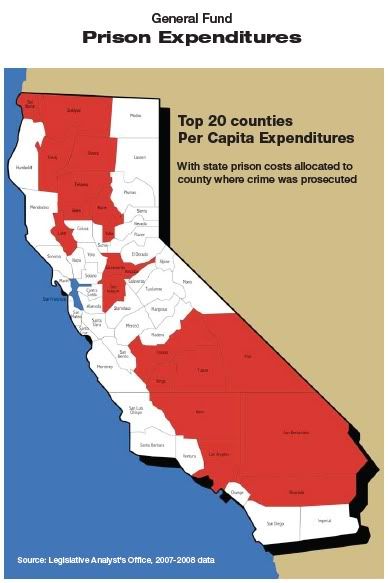
Most members of the public attended today’s hearing to address what is perhaps the governor’s most provocative natural resources proposal calling for the closure of 221 state parks. This is about 80% of all state parks.
As was testified by members of the public, closing state parks would impact the vacation plans of millions who live in and visit our state. This would have an economic impact on our state. According to the California State Parks Foundation, each dollar invested in state parks generates $2.35 cents in revenue for the state’s general fund. The public also testified that closing parks would risk the safety of cultural housed artifacts within our historic parks and create a public safety problem across our state.
A full list of the parks that will close if this proposal is enacted is available at http://www.calparks.org/takeaction/closurelist.html.
In public safety, the governor’s proposals primarily affect our state prisons system and our courts. Consider these proposals:
· $181 million in savings through commuting the sentences of undocumented immigrants in our state prison system and working with the federal government to deport them;
· $120.5 million in saving from releasing certain inmates one year early from prison and place them on house arrest with Global Positioning System monitoring for the remainder of their sentence;
· $99.9 million in savings by changing sentencing options for specific crimes that may be prosecuted either felonies or misdemeanors, making these offenses punishable by county jail and/or probation instead of state prison;
· $787.1 million in savings through eliminating funding for most rehabilitative services
· $168.6 million in cuts to our courts;
· $13 million in savings by phasing in electronic court reporting at a rate of 20% a year.
These cuts translate to real community impacts. The counties that sentence the most people to prison, subsequently resulting in state prison costs, are detailed in the map below which highlights these costs on a per capita basis.

Most members of the public attended today’s hearing to address what is perhaps the governor’s most provocative natural resources proposal calling for the closure of 221 state parks. This is about 80% of all state parks.
As was testified by members of the public, closing state parks would impact the vacation plans of millions who live in and visit our state. This would have an economic impact on our state. According to the California State Parks Foundation, each dollar invested in state parks generates $2.35 cents in revenue for the state’s general fund. The public also testified that closing parks would risk the safety of cultural housed artifacts within our historic parks and create a public safety problem across our state.
A full list of the parks that will close if this proposal is enacted is available at http://www.calparks.org/takeaction/closurelist.html.
Monday, June 1, 2009
Childcare, Education, and the Budget
Day 6 of the Conference Committee reviewed the Governor’s proposals affecting child care, K-12 education, and higher education.
Consider these child care proposals:
· Eliminating funding for community care licensing; and
· Eliminating funding for child care for for poor families who are transitioning back into employment through the CalWORKS program.
The latter proposal conforms with the governor’s proposal to eliminate CalWORKS funding. With unemployment now at nearly 11%, the overlay of these two proposals would, if enacted, have enormous effects on California families struggling under the weight of our current economic recession.
These childcare proposals amount to throwing our state’s women and children overboard when our state and our economy are in crisis. This is reinforced by the governor’s proposals affecting education.
In overall dollar amounts, the proposed education cuts are the largest cuts that the governor has offered in his May Revise budget. Consider these proposals for the next 13 months, applicable to the end of the current fiscal year and the 2009-2010 budget, include:
· $5.2 billion in cuts from K-12 education;
· $3.1 billion in cuts to higher education, including phasing out CalGrants (Note: approximately $1.2 billion in cuts would be backfilled with federal funds); and
· $935 million in cuts from community colleges.
Californians have prioritized education spending above all other areas of the budget. This is why education spending is the largest single component of the budget. In recent years, state expenditures for K-12 and higher education combined have been nearly half of the state budget. And, K-12 education funding is the single largest area of spending. As the largest pot of budget funds, K-12 education becomes a target in the governor’s approach to balancing the budget predominantly through cuts. These cuts will not be felt equally in communities across California due to differing levels of enrollment.
Consider these charts highlighting K-12 enrollment and the top 20 counties receiving K-12 spending on a per capita basis. The top 5 counties for education expenditure – the counties of Modoc, Tulare, Merced, San Bernardino and Imperial – are also among the poorest counties in the state.
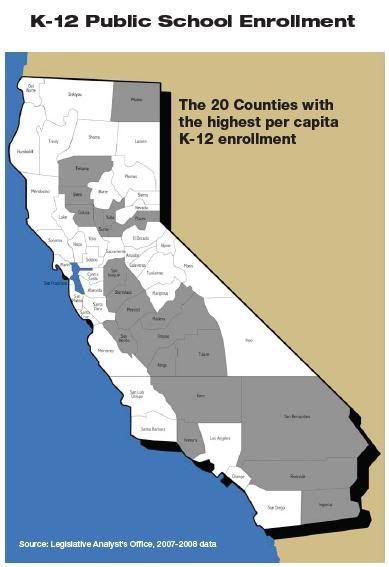

Consider these child care proposals:
· Eliminating funding for community care licensing; and
· Eliminating funding for child care for for poor families who are transitioning back into employment through the CalWORKS program.
The latter proposal conforms with the governor’s proposal to eliminate CalWORKS funding. With unemployment now at nearly 11%, the overlay of these two proposals would, if enacted, have enormous effects on California families struggling under the weight of our current economic recession.
These childcare proposals amount to throwing our state’s women and children overboard when our state and our economy are in crisis. This is reinforced by the governor’s proposals affecting education.
In overall dollar amounts, the proposed education cuts are the largest cuts that the governor has offered in his May Revise budget. Consider these proposals for the next 13 months, applicable to the end of the current fiscal year and the 2009-2010 budget, include:
· $5.2 billion in cuts from K-12 education;
· $3.1 billion in cuts to higher education, including phasing out CalGrants (Note: approximately $1.2 billion in cuts would be backfilled with federal funds); and
· $935 million in cuts from community colleges.
Californians have prioritized education spending above all other areas of the budget. This is why education spending is the largest single component of the budget. In recent years, state expenditures for K-12 and higher education combined have been nearly half of the state budget. And, K-12 education funding is the single largest area of spending. As the largest pot of budget funds, K-12 education becomes a target in the governor’s approach to balancing the budget predominantly through cuts. These cuts will not be felt equally in communities across California due to differing levels of enrollment.
Consider these charts highlighting K-12 enrollment and the top 20 counties receiving K-12 spending on a per capita basis. The top 5 counties for education expenditure – the counties of Modoc, Tulare, Merced, San Bernardino and Imperial – are also among the poorest counties in the state.
Subscribe to:
Posts (Atom)